
AI in Emergency Medicine
Beyond the Golden Hour: AI in Contested Battlefield Medicine
Why this matters
The Golden Hour assumption is dead in contested combat. AI-driven prolonged field care, autonomous MedEvac, and predictive triage are the new baseline.
Recommended next step
Pair this article with the free guide or course store if you want a more structured framework you can apply at the bedside or in leadership conversations.
What this article covers

Author and clinical perspective
Chester "Chet" Shermer, MD, FACEP
Founder, Global MedOps Command
Dr. Chet Shermer leads Global MedOps Command to help emergency physicians, EMS teams, and operational medical leaders strengthen clinical judgment, adopt AI responsibly, and train for high-stakes decisions.
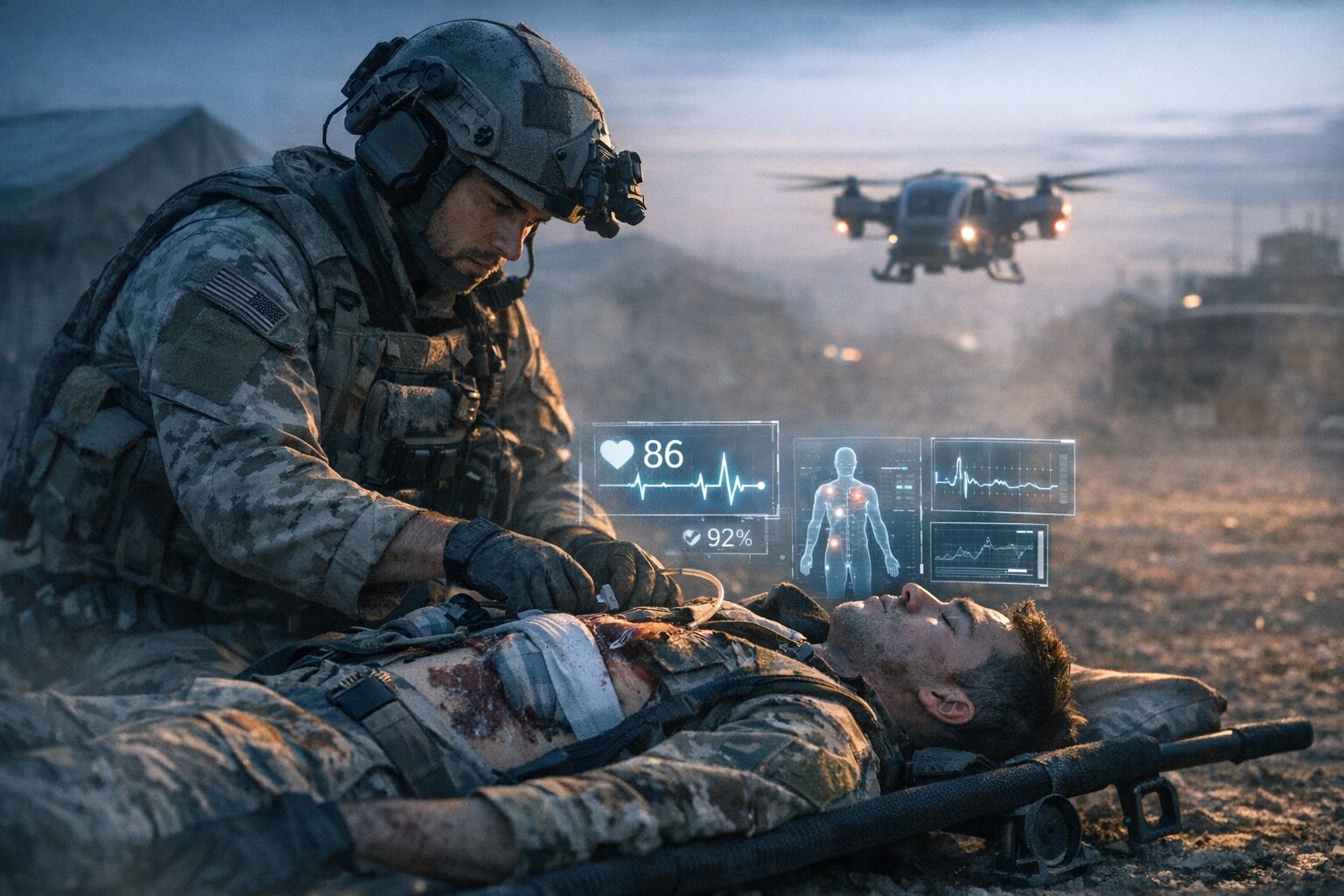
Beyond the Golden Hour: Why AI Is the Only Solution for Medicine in Contested Environments
Medically Reviewed By Dr. Chester Shermer, MD, FACEP | Published May 6, 2026 | 8 min read
The Golden Hour assumption is dead in contested combat. AI-driven prolonged field care, autonomous MedEvac, and predictive triage are no longer aspirational — they are the baseline requirement for keeping soldiers alive in large-scale combat operations.
The Death of the Golden Hour: Why Military Medicine Must Pivot
Picture this: the helicopter is not coming. Enemy air defenses have grounded every MedEvac asset within range, the nearest surgical team is three days away, and a soldier with a tension pneumothorax has maybe thirty minutes. This is not a worst-case hypothetical — it is the emerging baseline of modern large-scale combat operations (LSCO).
For two decades, the U.S. military's medical system was built around a single, powerful concept: get a wounded fighter to definitive surgical care within sixty minutes. That doctrine delivered a remarkable 98 percent survival rate for wounded soldiers who reached medical treatment in time during operations in Iraq and Afghanistan. It was a triumph of logistics, airpower, and speed.
But that era is over.
Prolonged Field Care (PFC): Medical treatment and management of a casualty beyond the "Golden Hour" — potentially for 24 to 72 hours or more — when evacuation is delayed or impossible due to operational conditions.
The U.S. military is now explicitly shifting focus toward contested environments where near-peer adversaries can deny air superiority, disrupt supply chains, and strand casualties on the battlefield for days. Contested logistics — the enemy's deliberate targeting of evacuation corridors, communications, and resupply routes — makes the Golden Hour model structurally unsound against a sophisticated opponent.
The survival calculus has fundamentally changed. Keeping a soldier alive now demands autonomous, intelligent intervention directly at the Point of Injury — and that is precisely where AI in army medicine enters as the critical force multiplier. The reality is uncomfortable but unavoidable: survival increasingly depends on smart systems stabilizing casualties before any human medic arrives.
AI at the Point of Injury: Triage and the Virtual Medic
When evacuation is impossible and a trained medic is nowhere nearby, the first responder may be a rifleman with minimal medical training and a soldier bleeding out at their feet. This is the reality of contested environments — and it is precisely the gap that artificial intelligence in military medicine is designed to close.
Augmented Reality as a Force Multiplier
DARPA is actively developing AI algorithms capable of guiding non-medical personnel through complex, life-saving procedures using augmented reality (AR) headsets. Imagine it as a surgical GPS overlaid directly onto the casualty's body — step-by-step instructions, real-time anatomical guidance, and decision support delivered to someone who may have never performed a needle decompression in their life. This technology does not replace the medic. It temporarily becomes one.
This approach addresses a brutal arithmetic problem in Tactical Combat Casualty Care (TCCC): in a mass casualty event, there are never enough trained hands. AR-assisted guidance extends medical capability across every soldier on the battlefield, transforming every squad member into a provisional first responder without years of clinical training. For a deeper exploration of how scenario-based simulation training reinforces these AR-guided procedures before the soldier ever needs them in combat, see the EMS simulation platform at emsmedsim.globalmedopscommand.com.
Wearables, Computer Vision, and Automated Triage
Wearable biosensors are quietly rewriting how battlefield triage works. AI-powered wearables continuously monitor vitals — heart rate, blood pressure, oxygen saturation, respiratory rate — and automatically prioritize casualties when medics are overwhelmed by volume. Rather than a medic manually assessing ten wounded soldiers, the system surfaces who needs attention right now versus who can wait.
Alongside wearables, computer vision tools enable rapid trauma assessment in mass casualty scenarios, analyzing injury patterns faster than human observation alone.
Key AI-driven TCCC tools already in development or deployment include:
- Biosensor wearables that flag hemodynamic instability in real time
- AR procedural guidance overlays for tourniquet application and airway management
- Computer vision triage platforms that classify wound severity from visual data
- Predictive algorithms that estimate deterioration timelines based on vital trends
These technologies do not operate in isolation, though — their true potential emerges when paired with a system capable of moving the casualty out of harm's way. That is where autonomous evacuation platforms enter the equation.
Autonomous Evacuation: Solving the MedEvac Challenge
If the virtual medic handles stabilization at the point of injury, the next critical problem is movement. Getting a casualty off a contested battlefield without sending more personnel into the line of fire is exactly where autonomous evacuation technology is rapidly changing the calculus.
Self-driving ground vehicles and VTOL drones are now being equipped with life-support AI to stabilize patients during transport — a development that reframes what is possible when human MedEvac crews simply cannot fly.
The gap between traditional and autonomous MedEvac is significant:
| Factor | Traditional MedEvac | Autonomous MedEvac |
|---|---|---|
| Crew risk | High — pilots and medics exposed | Minimal — remote oversight only |
| Availability | Grounded by air defenses | Operates in contested airspace |
| Response speed | Dependent on crew readiness | On-demand, 24/7 deployment |
| En-route care | Requires onboard medic | Closed-loop AI adjusts O₂ and fluids automatically |
| Terrain flexibility | Limited landing zones | Ground robots access narrow corridors |
The closed-loop life support component deserves special attention. Rather than simply transporting a patient, AI-driven systems continuously monitor vitals and adjust oxygen delivery and fluid resuscitation in real time — essentially functioning as an automated critical-care nurse for the duration of transit.
On the ground, autonomous robotic platforms can sweep forward positions and extract casualties from areas where sending a human would be a death sentence. This is human-machine teaming in its most practical form: the algorithm handles the dangerous retrieval while the medic remains at a safe distance, coordinating triage remotely.
The broader role of AI in military healthcare does not stop at extraction. The next frontier involves systems that do not wait for a soldier to become a casualty at all — predicting threats to health before they become emergencies.
Predictive Health: Identifying the Invisible Killers
Stabilization and evacuation address casualties that have already occurred. But the most effective intervention happens before a soldier ever hits the ground. This is the "left of bang" philosophy — and AI is making it a clinical reality on the battlefield.
Sepsis Detection Before the First Symptom
Sepsis kills quietly. In a combat environment, the window between infection and organ failure can close faster than any resupply run. AI systems trained on continuous biosensor data can analyze subtle changes in heart rate variability (HRV) to predict sepsis up to 48 hours before a fever even develops. That is nearly two full days of treatment window that would otherwise be invisible without lab equipment. In austere forward environments, that lead time is the difference between antibiotics and a medevac.
Internal Hemorrhage: Reading the Trend, Not the Number
A single vital sign reading means little. A trend means everything. Machine learning models trained on continuous streams of blood pressure, respiratory rate, and pulse oximetry can detect the subtle, progressive drift that signals internal bleeding long before a soldier appears clinically unstable. This kind of pattern recognition sits at the core of next-generation tactical combat casualty care AI, extending the diagnostic capabilities of a combat medic far beyond what manual monitoring allows.
Mental Health: The Wounds That Do Not Bleed
Non-battle injuries (NBIs) — including burnout, PTSD, and stress-related degradation — account for a significant portion of military medical losses. AI tools now analyze speech patterns and sleep data to flag early indicators of psychological distress before performance breaks down. Continuous soldier readiness analytics shift mental health from reactive treatment to proactive prevention.
These predictive capabilities are genuinely transformative — but they also raise harder questions. Building AI that can forecast a soldier's death or psychological collapse requires vast amounts of sensitive training data, and that is where the real friction begins.
The Data Desert and Ethical Guardrails
The promise of AI-driven battlefield medicine — from autonomous medical evacuation platforms to predictive triage algorithms — runs directly into a hard wall of practical and moral reality. The technology is advancing. The deployment, however, is lagging. Two interconnected obstacles explain why.
The first is what researchers have termed the "Data Desert." Military medical data is deeply fragmented, inconsistently formatted, and often classified — making it nearly impossible to train robust AI models. Combat casualty records do not follow standardized schemas. OPSEC requirements mean sensitive engagement data cannot be shared across development teams. And HIPAA-equivalent protections create additional friction around individual medical records, even in a military context.
Implementation barriers every developer must understand:
- Fragmented records across theater commands and service branches
- Classification conflicts that prevent data pooling for model training
- Inconsistent data labeling from field-generated casualty reports
- Limited ground-truth outcomes — what happened after evacuation is rarely captured
The second obstacle is ethical. When an algorithm recommends withholding resources from one soldier to prioritize another, accountability cannot be diffuse.
"Ethical considerations must focus on the morality of automated medical decisions and the 'Human-in-the-Loop' model." — Army University Press
That phrase — Human-in-the-Loop — is critical. Most defense medical ethicists agree that AI should recommend, never decide unilaterally. However, in a degraded communications environment, that guardrail gets complicated fast.
Trust compounds everything. A medic who does not understand why an AI flagged a patient as lower priority will not follow its guidance. Transparency in model reasoning is not a nice-to-have; it is a prerequisite for adoption. The same governance and documentation patterns I have written about for civilian ED settings apply here, and the resolution framework I published recently on Medium — When the Algorithm Disagrees With Your Clinical Judgment — translates directly to combat medicine. Solving these barriers is arguably the most important work happening in this space right now.
Dr. Chet's Take
I have spent enough time in critical care transport, telemedicine, and military medical roles to know what happens when doctrine collides with operational reality. The Golden Hour worked because we owned the air. We will not always own the air. The hard part of this transition is not the technology. It is the doctrine, the training, and the willingness of senior medical leadership to plan for prolonged field care as the primary model rather than the contingency.
I tell every junior medic and physician I work with the same thing: the algorithm is a tool, not a replacement for judgment. When you are looking at a casualty in front of you and the AI is telling you something that does not match what your hands are telling you, your hands win. Document the disagreement. Move on. Do the work. The systems described above will keep more soldiers alive than the Golden Hour model ever did, but only if the humans operating them stay sharp enough to override them when they are wrong.
— Chester Shermer, MD, FACEP | Emergency Medicine, 25+ Years Clinical Experience | State Surgeon
Conclusion: The Future of Force Health Protection
The path forward is clear. As peer adversaries continue to develop capabilities that deny air superiority and disrupt evacuation corridors, prolonged field care technology powered by AI is not a luxury — it is the baseline requirement for keeping soldiers alive in future conflicts. Every thread above leads to the same conclusion: there is no credible alternative.
These stakes extend well beyond the battlefield. Health-tech developers are increasingly pursuing dual-use opportunities, engineering military medical AI systems with architecture that can translate directly into civilian emergency rooms. What saves a soldier in a contested environment today could reduce mortality in an under-resourced trauma center tomorrow.
The most important investment the defense health community can make right now is in data standardization — because no algorithm, however sophisticated, performs well in a data desert.
For developers and military medical officers alike, this is the call to action. Prioritize interoperable data frameworks. Fund rigorous validation studies. Build the infrastructure now, before the next conflict makes the absence of it catastrophic.
Key Takeaways
- The Golden Hour doctrine was built on uncontested air superiority. In large-scale combat operations against a near-peer adversary, that assumption no longer holds.
- Prolonged Field Care is becoming the primary doctrine, not the contingency, requiring autonomous stabilization at the point of injury.
- AI-driven AR procedural guidance extends medical capability to non-medical personnel during mass casualty events.
- Autonomous ground and aerial MedEvac platforms with closed-loop life support deliver en-route critical care without putting human crews at risk.
- Predictive AI can flag sepsis up to 48 hours before fever, detect internal hemorrhage from vital trends, and identify mental-health degradation before performance breaks down.
- The two biggest obstacles are the military medical "Data Desert" and unresolved ethical questions about Human-in-the-Loop accountability in degraded communications environments.
Frequently Asked Questions
Q: What is Prolonged Field Care (PFC) and why does it matter?
A: PFC is medical treatment of a casualty for 24 to 72 hours or more when evacuation is delayed or impossible. It matters because contested environments — where adversaries deny air superiority — make traditional sixty-minute evacuation timelines structurally unrealistic.
Q: Will AI replace combat medics?
A: No. AI augments medics by extending diagnostic and procedural capability to non-medical personnel during mass casualty events and by automating routine monitoring. The medic remains the decision-maker; the algorithm recommends.
Q: How realistic are autonomous MedEvac platforms in 2026?
A: Multiple autonomous ground and VTOL platforms are in active development and field testing. Operational deployment at scale is still 3 to 7 years out for most systems, but closed-loop life support modules and remote-piloted ground evacuation are already in limited use.
Q: What is the biggest obstacle to AI in military medicine?
A: The "Data Desert." Military medical data is fragmented, classified, and inconsistently labeled, which severely constrains the ability to train robust models. Data standardization across theater commands and service branches is the most important near-term investment.
Q: How does this translate to civilian emergency medicine?
A: Significantly. The same closed-loop life support, predictive sepsis detection, and AR-guided procedural support being developed for combat translate directly to under-resourced trauma centers, rural EDs, prehospital care, and mass casualty incident response.
Medical Disclaimer
This content is intended for licensed medical professionals, military medical personnel, and trained emergency responders. It does not constitute personalized medical advice. Clinical and operational protocols referenced are for educational purposes and should be adapted to your jurisdiction's scope of practice, institutional policy, and applicable medical direction.
Continue Your Training
If you're an emergency physician (or any clinician treating patients daily) trying to understand how AI will actually impact your clinical practice — not just the hype — I put together a free practical guide. You can download the AI in EM Survival Guide here.
Browse All Courses at Global MedOps Command
Relevant Reading on Global MedOps Command:
- How to Avoid Becoming an AI Casualty — Dr. Shermer's guide to navigating AI tools in clinical and operational settings without compromising judgment or patient outcomes.
- Emergency Department Efficiency Playbook — Practical systems for throughput, triage optimization, and operational efficiency.
- Read more from Dr. Shermer on Medium
Connect with Dr. Shermer: LinkedIn — Chester "Chet" Shermer, MD, FACEP
References
- Frontiers in Public Health, "AI-driven predictive analytics for soldier readiness and mental health monitoring," 2026. frontiersin.org
- National Institute of Biomedical Imaging and Bioengineering, "Beyond the Golden Hour: Workshop Report," May 2019. nibib.nih.gov
- Army University Press, "Ethical Considerations of AI in Military Medicine." armyupress.army.mil
- American Medical Association, "AMA Principles for Augmented Intelligence (AI) Development, Deployment, and Use." ama-assn.org
Published by Global MedOps Command | globalmedopscommand.com "Prepared for Every Emergency. Educated for Every Challenge."
Do not stop at awareness
Turn this article into a concrete next step while the issue is still fresh.
Move from reading into a practical next step if this issue already affects your workflow, department, or training decisions.
Author and expertise
Chester "Chet" Shermer, MD, FACEP
Founder, Global MedOps Command
Dr. Chet Shermer leads Global MedOps Command to help emergency physicians, EMS teams, and operational medical leaders strengthen clinical judgment, adopt AI responsibly, and train for high-stakes decisions.
Through courses, simulation platforms, books, and practical resources, he translates frontline emergency medicine, transport, and military leadership experience into tools clinicians can use immediately.
This article is published through Global MedOps Command to help emergency clinicians evaluate AI, workflow, and operational decisions with a physician-led perspective.
View the full author hubClinical application depth
Evidence-aware AI adoption still depends on clinician judgment, local validation, and operational context.
Even when a topic looks persuasive on first read, the practical work begins when physicians translate it into local policy, escalation thresholds, training expectations, and failure-mode review. That is where credibility is gained or lost.
What to pressure-test next
Questions for the next leadership discussion
Build the next step from this article
Strengthen topical depth, related reading, and the right conversion path.
Keep readers inside the same topic cluster with related articles, then channel them toward the guide, course, books, simulation, or contact path that best matches the problem this article surfaced.
Course
Move from insight into a repeatable framework
Use the flagship course when you want a structured way to evaluate AI tools, pressure-test claims, and protect clinical judgment.
See the AI course detailsSimulation
Practice the decision path under pressure
Use EM-Sim when you want scenario-based repetition that turns article-level insight into physician-facing emergency-medicine reps.
Explore EM-SimGuide
Take the quickest next step
Use the free survival guide when you want the shortest path from this article into a practical emergency-medicine AI overview.
Get the Free GuideRelated reading inside Global MedOps Command
AI in Emergency Medicine
AI in Emergency Medicine: Your Triage Is Already Obsolete
Discover how AI is transforming emergency medicine triage. Dr. Shermer shares 25 years of EM insights on becoming AI bulletproof. Start today. It is 0300
Read related articleAI in Emergency Medicine
AI Literacy in Emergency Medicine: What You Need to Know
Emergency physicians using AI tools without understa
Read related articleAI in Emergency Medicine
Responding to AI Diagnostic Failures in Emergency Medicine
Every technology introduced into emergency medicine eventually produces its first sentinel event. Computerized physician order entry was supposed to elimin
Read related article