
AI in Emergency Medicine
Responding to AI Diagnostic Failures in Emergency Medicine
Why this matters
Every technology introduced into emergency medicine eventually produces its first sentinel event. Computerized physician order entry was supposed to elimin
Recommended next step
Pair this article with the free guide or course store if you want a more structured framework you can apply at the bedside or in leadership conversations.
What this article covers

Author and clinical perspective
Chester "Chet" Shermer, MD, FACEP
Founder, Global MedOps Command
Dr. Chet Shermer leads Global MedOps Command to help emergency physicians, EMS teams, and operational medical leaders strengthen clinical judgment, adopt AI responsibly, and train for high-stakes decisions.
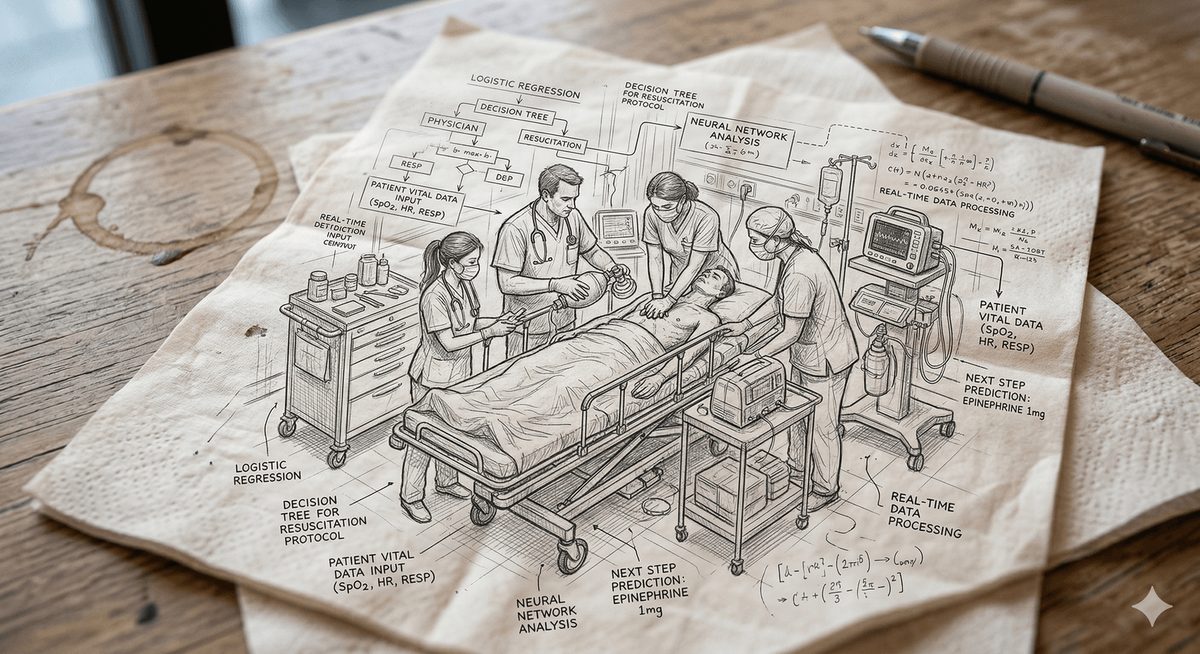
Every technology introduced into emergency medicine eventually produces its first sentinel event. Computerized physician order entry was supposed to eliminate medication errors — and it introduced an entirely new category of them. Sepsis alert systems were supposed to save lives — and they generated enough false positives that nurses began overriding them by reflex. The history of clinical informatics is a history of tools that solved one problem and created three more that no one anticipated.
AI diagnostic tools are following the same arc. The question is not whether they will fail. They already are. The question is whether the emergency physicians using them understand how they fail, can recognize failure in real time, and have a decision framework for what to do when the algorithm and the patient tell different stories.
HOW AI DIAGNOSTIC TOOLS FAIL IN THE ED
AI diagnostic failures in emergency medicine cluster into four recognizable patterns. Understanding them is the first step toward not becoming their victim.
Do not stop at awareness
Turn this article into a concrete next step while the issue is still fresh.
If this problem already affects your documentation, workflow, or leadership conversations, move next into the guide, course, or related resource instead of leaving the insight at article level.
The first is distribution shift. Every AI diagnostic tool was trained on a specific patient population. When your patient falls outside that population — different demographics, different comorbidity profile, different disease prevalence — the algorithm's outputs become less reliable, sometimes dramatically so. A chest X-ray AI trained predominantly on data from large urban academic centers may perform differently in a patient population with higher rates of endemic fungal disease, prior TB exposure, or unusual occupational lung pathology. The algorithm doesn't know it's outside its training distribution. It will still generate a probability estimate. That estimate just means less than it did for the patients it was built on.
The second failure pattern is label propagation error. AI algorithms learn from historical clinical data, and historical clinical data contains the diagnostic errors, biases, and practice variation of the humans who generated it. If a training dataset systematically under-diagnosed pulmonary embolism in younger women — a well-documented historical pattern — an algorithm trained on that data will inherit that blind spot. The algorithm is not neutral. It reflects the clinical culture that generated its training labels.
The third pattern is threshold miscalibration. Most AI diagnostic tools output a probability estimate, and the clinical workflow converts that probability into an action recommendation based on a threshold — high risk, low risk, recommend CT, discharge safe. Those thresholds are calibrated on the training population. In your patient population, with your disease prevalence and your patient demographics, the threshold may be wrong. A tool calibrated to a high-prevalence PE population will over-call PE in a low-prevalence setting. A tool calibrated to a low-prevalence setting will under-call in a high-prevalence one. If you don't know what prevalence your tool was calibrated on, you don't know whether its thresholds are right for your patients.
The fourth pattern is adversarial fragility — the algorithm's vulnerability to unusual inputs. AI image analysis tools that perform excellently on standard-quality images can fail in unpredictable ways on technically degraded images: portable chest X-rays in a diaphoretic patient who can't hold still, ECGs with baseline artifact from a shivering hypothermic patient, CT scans with motion artifact in an agitated trauma patient. These are precisely the patients where diagnostic accuracy matters most and where AI tool performance is least reliable.
THE COGNITIVE TRAP: AUTOMATION BIAS
The most dangerous consequence of AI diagnostic tools is not the failure itself — it is the cognitive response to apparent algorithmic confidence. Automation bias is the well-documented human tendency to over-weight automated system outputs relative to other available information. It is not a character flaw. It is a feature of how human cognition handles information under cognitive load, and emergency physicians operating on hour fourteen of a night shift are not immune to it.
The clinical signature of automation bias in AI-assisted diagnosis looks like this: the algorithm says low probability, the physician updates their clinical probability downward, and the findings that would have triggered further workup — the subtle tachycardia, the slightly elevated D-dimer, the vague family history — get anchored out of the decision process. The miss that follows is not a failure of clinical knowledge. It is a failure of the physician-algorithm interface.
Recognizing automation bias as a risk is the first line of defense against it. The second is a deliberate clinical practice: generate your own pre-test probability before you look at the algorithm's output. If your clinical gestalt and the algorithm's output diverge significantly, that divergence is a signal — not necessarily that the algorithm is wrong, but that one of you is seeing something the other is not. That is precisely the moment for deeper clinical reasoning, not deference.
A COMMAND FRAMEWORK FOR AI DIAGNOSTIC DISAGREEMENT
Military medicine has a concept that translates directly here: the commander's critical information requirement. Before any operation, a commander defines in advance what information, if received, would require a change in the current plan. This is not reactive decision-making — it is prospective threshold-setting that allows a commander to act decisively when conditions change, without being paralyzed by ambiguity in the moment.
Emergency physicians can apply the same framework to AI-assisted diagnosis. For each AI tool active in your clinical workflow, define in advance: what clinical finding, if present, would cause me to disregard or override this algorithm's output regardless of its probability estimate? For a chest pain AI risk stratification tool, that threshold might be: any new ST changes, any hemodynamic instability, any prior history of aortic pathology. Write it down mentally. Own it as your clinical standard.
The physician who has prospectively defined their override criteria is far less vulnerable to automation bias than the one who decides in the moment — under cognitive load, under time pressure, with an algorithm confidently displaying a low-risk probability — whether the clinical picture is concerning enough to act.
This is what AI-bulletproof practice looks like in the diagnostic domain. Not refusing to use the tools. Not uncritically trusting them. Using them as one input in a structured clinical reasoning process that you — not the algorithm — control.
---DR. CHET'S TAKE---
I've been overriding clinical tools my entire career — lab values that didn't match the patient in front of me, imaging reads that missed what I was seeing on ultrasound, risk scores that stratified a sick patient as low risk. AI diagnostic tools are the newest version of that challenge, and the override calculus is the same: the tool informs my judgment, it does not replace it.
What concerns me about the current moment is not that AI tools fail. Every tool fails. What concerns me is that a generation of emergency physicians is being trained in environments where AI outputs are embedded in the workflow before the culture of critical evaluation has been established. When the algorithm is always there and usually right, the skill of recognizing when it's wrong atrophies. That is the diagnostic failure no one is measuring.
In my programs — including air medical and critical care transport, where diagnostic errors in the field have no safety net — we train to the failure mode, not just the standard case. Every provider who operates with AI-assisted tools needs to be able to articulate: how does this tool fail, and what am I watching for? If you can't answer that, you're not using the tool. The tool is using you.
— Dr. Chester "Chet" Shermer, MD, FACEP is a Professor of Emergency Medicine, Medical Director for Air Medical and Critical Care Transport programs, and a military medical commander with the Army National Guard. He is the founder of Global MedOps Command and the creator of AI in Emergency Medicine: Becoming AI Bulletproof.
AI Won't Wait. Neither Should You.
The diagnostic failure patterns described in this post are already occurring in departments where AI tools are active in clinical workflows without a structured physician override framework. Emergency physicians who understand how these tools fail — and who have prospectively defined their own override criteria — will catch what the algorithm misses. Those who don't will eventually sign their name to an outcome the algorithm caused and the patient paid for.
Consider enrolling in my course: AI in Emergency Medicine: Becoming AI Bulletproof — a physician-built course covering AI diagnostic accountability, automation bias recognition, and the clinical command frameworks you need to practice confidently in an AI-integrated environment.
Incident response framework
A physician-owned response model after AI diagnostic failure or near miss
The hardest moment in AI adoption is not the pilot launch. It is the first time the tool contributes to a diagnostic miss, a harmful delay, or a near miss that exposes how weak the local response process really is.
The RESET model after an AI-related failure
A disciplined response model is RESET: rescue the immediate patient issue, examine what the system saw, surface workflow contributors, escalate the incident, and translate the lesson into policy. This prevents the organization from reducing a meaningful event to vague frustration.
Why blame is the wrong endpoint
A bad output matters, but the more important question is why the system was allowed to influence a high-risk decision without sufficient safeguards. Strong teams avoid the trap of blaming one clinician, one vendor, or one confusing screen and instead ask what the event revealed about governance and design.
The credibility test after the event
Departments regain credibility when they can show what changed: new review rules, better escalation logic, narrower use cases, clearer documentation expectations, or a decision to pull the tool back. Incident response is credible only when the lesson is visible in later behavior.
Contextual next step
Read the override framework
Use the override article if you want the bedside decision logic that should prevent some failures from becoming larger events.
Open resourceContextual next step
Practice escalation through simulation
Simulation is a useful next step when your team needs reps around escalation, communication, and failure review under pressure.
Open resourceContextual next step
Book a physician-led advisory discussion
Use the consulting pathway if you need department-level support for governance, after-action review, or safe pilot redesign.
Open resourceArticle FAQ
Should a single AI-related error end a pilot immediately?
Not always, but it should trigger a serious review of the use case, safeguards, escalation pathway, and human-review expectations. Some events justify narrowing or pausing the tool until the response is credible.
Article FAQ
Who should review a diagnostic AI failure?
Review should involve the treating clinicians, operational leaders, quality or governance stakeholders, and any technical or vendor partners needed to understand how the output was generated and why it was trusted.
Selected references
Leveraging Artificial Intelligence to Reduce Diagnostic Errors in Emergency Medicine
Supports the discussion of AI as assistive decision support that still requires stakeholder involvement and careful clinical integration.
View sourceArtificial Intelligence in Emergency Medicine: Viewpoint of Current Applications and Foreseeable Opportunities and Challenges
Useful for the emergency-medicine setting and the need for practical safety governance around deployment.
View sourceAuthor and expertise
Chester "Chet" Shermer, MD, FACEP
Founder, Global MedOps Command
Dr. Chet Shermer leads Global MedOps Command to help emergency physicians, EMS teams, and operational medical leaders strengthen clinical judgment, adopt AI responsibly, and train for high-stakes decisions.
Through courses, simulation platforms, books, and practical resources, he translates frontline emergency medicine, transport, and military leadership experience into tools clinicians can use immediately.
This article is published through Global MedOps Command to help emergency clinicians evaluate AI, workflow, and operational decisions with a physician-led perspective.
View the full author hubClinical application depth
Evidence-aware AI adoption still depends on clinician judgment, local validation, and operational context.
Even when a topic looks persuasive on first read, the practical work begins when physicians translate it into local policy, escalation thresholds, training expectations, and failure-mode review. That is where credibility is gained or lost.
What to pressure-test next
Questions for the next leadership discussion
Build the next step from this article
Strengthen topical depth, related reading, and the right conversion path.
Keep readers inside the same topic cluster with related articles, then channel them toward the guide, course, books, simulation, or contact path that best matches the problem this article surfaced.
Course
Move from insight into a repeatable framework
Use the flagship course when you want a structured way to evaluate AI tools, pressure-test claims, and protect clinical judgment.
See the AI course detailsSimulation
Practice the decision path under pressure
Use EM-Sim when you want scenario-based repetition that turns article-level insight into physician-facing emergency-medicine reps.
Explore EM-SimGuide
Take the quickest next step
Use the free survival guide when you want the shortest path from this article into a practical emergency-medicine AI overview.
Get the Free GuideRelated reading inside Global MedOps Command
AI in Emergency Medicine
AI in Emergency Medicine: Your Triage Is Already Obsolete
Discover how AI is transforming emergency medicine triage. Dr. Shermer shares 25 years of EM insights on becoming AI bulletproof. Start today. It is 0300
Read related articleAI in Emergency Medicine
AI Literacy in Emergency Medicine: What You Need to Know
Emergency physicians using AI tools without understa
Read related articleAI in Emergency Medicine
Beyond the Golden Hour: AI in Contested Battlefield Medicine
The Golden Hour assumption is dead in contested combat. AI-driven prolonged field care, autonomous MedEvac, and predictive triage are the new baseline.
Read related article